

Parkinson’s Management
A diagnosis of Parkinson’s can affect movement, confidence, balance, mobility, posture, speech, and independence.
Many people notice that everyday activities become slower, smaller, and more effortful over time. Walking may become more difficult, balance may feel less reliable, and tasks that were once automatic can start to take much more concentration.
However, evidence shows that the right rehabilitation approach can make a significant difference.
At our service, we provide specialist Parkinson’s rehabilitation that is evidence based, highly individualised, and focused on helping people maintain and improve function, confidence, and quality of life.
Parkinson’s Affects Everyone Differently
Parkinson's Disease affects people in different ways.
Some people may struggle most with walking and balance, while others may be more affected by stiffness, freezing, fatigue, posture, tremor, hand function, or confidence leaving the house.
Because no two people experience Parkinson’s in the same way, rehabilitation should never be generic.
We build every programme around the person, their symptoms, and the goals that matter most to them.
These goals may include:
Walking more confidently
Improving balance and reducing falls
Managing freezing episodes
Getting outdoors more safely
Returning to the gym or exercise
Improving posture and movement
Building confidence in public places
Improving hand function and dexterity
Staying independent at home
Returning to hobbies, sport, or social activities
Evidence-Based Parkinson’s Rehabilitation
Research shows that exercise and movement-based rehabilitation are some of the most important parts of Parkinson’s management.
Targeted exercise can improve walking, balance, mobility, posture, strength, confidence, and quality of life.
Our rehabilitation programmes are based on proven neurological physiotherapy principles, including:
Large amplitude movement training
Task-specific practice
Balance retraining
Gait rehabilitation
Strength and conditioning
Cueing strategies
Dual-task training
Cardiovascular exercise
Outdoor mobility practice
Functional strengthening
Fatigue management and pacing
The aim is not simply to maintain function for as long as possible. The aim is to help people move better, stay active, and continue doing the things that matter to them.
Large Power-Based Movements
One of the common features of Parkinson’s is that movement can become smaller, slower, and less automatic.
People may notice shorter steps, reduced arm swing, difficulty getting up from chairs, quieter voice, slower walking, and reduced confidence moving around.
Evidence-based Parkinson’s rehabilitation often focuses on large amplitude, high effort movements.
This type of training helps people relearn what “normal” movement feels like.
Exercises may focus on:
Bigger steps
Faster walking
Larger arm movements
More upright posture
Stronger turns and transfers
Powerful sit-to-stand practice
Larger reaching and bending movements
These movements can improve walking speed, balance, confidence, and overall mobility.
Outdoor Mobility and Community Confidence
Many people with Parkinson’s gradually lose confidence walking outdoors.
Busy environments, uneven ground, curbs, crowds, hills, crossings, and distractions can all increase anxiety and make movement more difficult.
We provide practical outdoor mobility training to help people feel safer and more confident in the community.
This may include:
Walking outdoors in different environments
Managing uneven surfaces
Practising crossings and curbs
Navigating shops and public places
Improving confidence with hills and stairs
Managing freezing episodes outdoors
Building endurance for longer walks
The goal is to help people stay active, independent, and connected to the activities they enjoy.
Individual Task Practice
Parkinson’s often affects the specific tasks that matter most in daily life.
For one person this may be getting in and out of bed. For another it may be carrying shopping, gardening, climbing stairs, writing, getting dressed, or getting up from the floor.
That is why we use task-specific rehabilitation.
Rather than only doing general exercises, we practise the real-life activities that each person wants to improve.
This may include:
Bed mobility
Transfers
Turning in tight spaces
Getting in and out of cars
Carrying objects safely
Stair practice
Dressing and personal care tasks
Returning to hobbies and exercise
This approach helps make progress more meaningful and more relevant to everyday life.
Individualised Goal Attainment
We believe rehabilitation should always be guided by the goals of the individual.
Some people want to walk further. Others want to reduce falls, stay active, travel, return to golf, continue gardening, or simply feel more confident leaving the house.
We work closely with each person to identify realistic, meaningful goals and track progress over time.
This may include improvements in:
Walking distance
Balance
Confidence outdoors
Speed of movement
Transfers and mobility
Falls frequency
Fitness and endurance
Independence at home
Participation in hobbies and social activities
By focusing on meaningful outcomes, rehabilitation becomes more motivating, more practical, and more effective.
Specialist Support for Long-Term Parkinson’s Management
Parkinson’s is a progressive condition, but that does not mean people cannot improve.
With the right rehabilitation approach, it is possible to move better, feel more confident, stay active, and continue taking part in the activities that matter most.
Our role is to provide expert guidance, evidence-based treatment, and ongoing support to help people achieve the best possible quality of life.
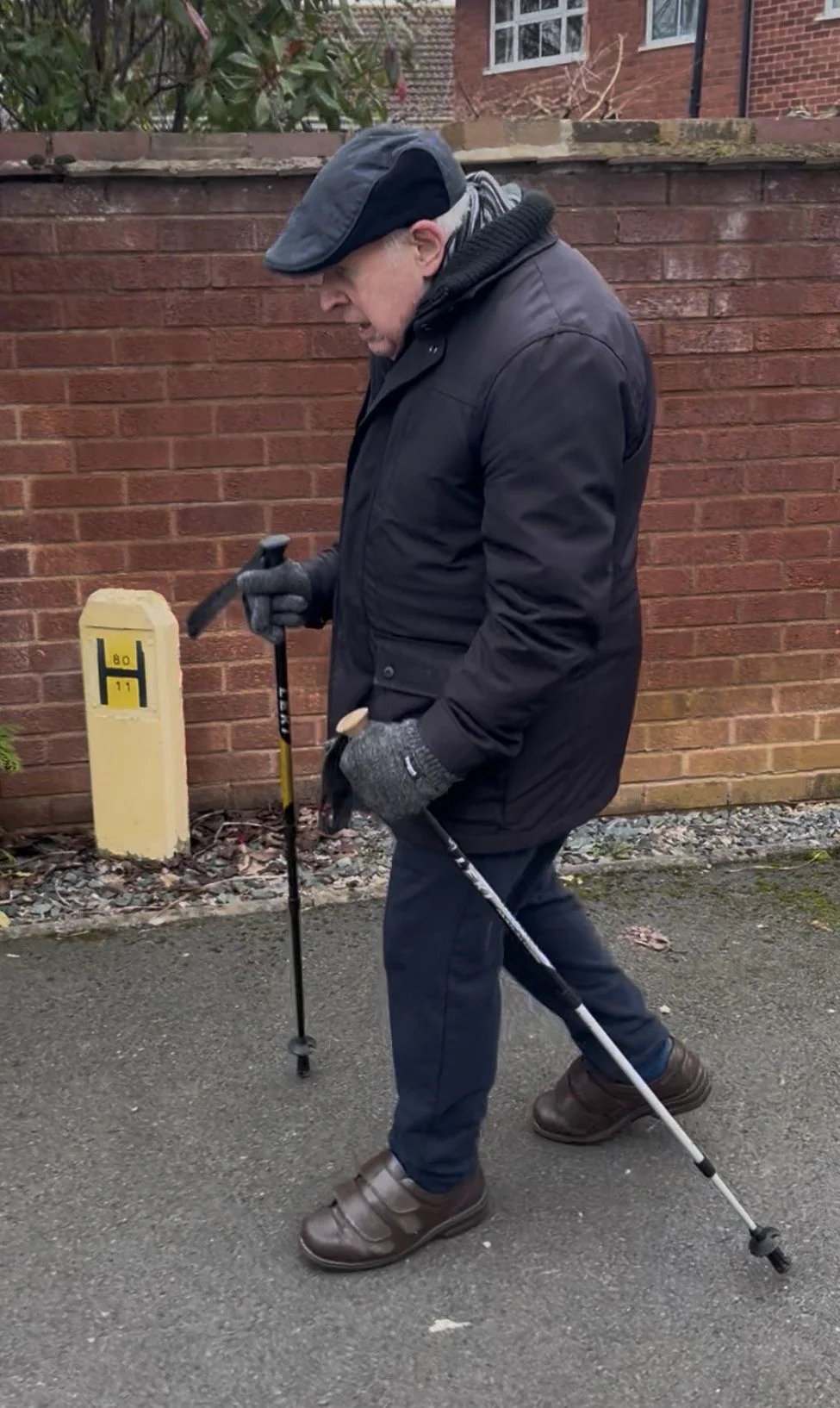
‘‘Therapy was seamlessly integrated into the home environment. Chris practised getting in and out of his chair and bed, walking around the house in structured circuits, and gradually building the confidence to move more freely. As his strength improved, sessions progressed to more advanced activities, including getting into the car, walking outdoors, and even short bursts of running on the spot.
The progress has been remarkable. Chris went from being unable to stand or walk independently to regaining the ability to walk unaided for periods of time, get himself in and out of bed, and move confidently around the house. He is now able to go out for walks along the road and in the local park, and has even returned to trips to the shops—something that once felt out of reach.’’ Maureen (Wife of Chris)
Read Chris’s full Parkinsons journey: